While many people are winding down for the year, the Honorary Rangers are still pulling out all the stops to get as much as possible done, before our amazing volunteers take a well-earned break.
It has been an exciting year. Our numbers have grown and we successfully embarked on an ambitious but essential project: the Restore Our Veld Campaign. Our on-going projects expanded, or continued, and many new small initiatives are being explored.
We are so encouraged by the very many property-owners and businesses/builders/ architects supporting the work we do. We are also particularly grateful for the great co-operation and partnership that has developed with several of the Municipal departments, especially Conservation. Without all these helping hands we would not be able to achieve our goals.
Of course, my personal thanks go to our Marloth Park Honorary Rangers themselves. You are our most valuable asset. You are without a doubt our solid foundation, to build on for the year to come. Your high standards of conservation ethics set an example from which everybody can learn. I am proud to be part of this friendly, energetic and committed team.
The beautiful cheetah is a slender, graceful cat with long legs, built for speed. It has a pale yellow coat with solid black spots (anything between 2 000 and 3 000) and black ‘tear’ marks running from the corners of its eyes to the corners of its mouth. The long, white-tipped tail is used as a rudder during high speed hunts and its claws are only semi-retractable, being visible at all times. These act as ‘running spikes’, and are worn down whilst running, in the same way as a dog’s are.
The cheetah is the only big cat that can purr without interruption, whilst inhaling and exhaling. Cats that roar can only purr whilst exhaling; cheetahs can purr, growl, spit and hiss, but cannot roar. The female calls its cubs with bird-like chirps.
The cheetah is the fastest animal on earth, reaching a top speed of 100kph within three seconds, maintaining a speed of 87kph during the hunt. At their top speed, the stride spans 6-7 metres!
The female cheetah is solitary, except when mating and raising her cubs. She can have up to 9 cubs but 3-4 is the norm. These have a mantle of fur from the neck to the tail which makes them look like the dreaded honey badger, and also helps to camouflage them in long grass. The mortality rate is extremely high – up to 70% of cubs perish within their first year – often caused by lions. The cubs remain with the mother until 1 or 2 years of age, during which time she will teach them how to hunt and fend for themselves. They will gradually move away, the females to a solitary existence, the males forming coalitions.
The male coalitions comprise at least two brothers, with a non-related male sometimes joining. There may be five or more cheetahs in a coalition if there is sufficient prey, but usually no dominance, as the males are related.
Cheetahs are found in both Africa and Asia, but in each region are classed as unique species with their own DNA. Only 50 Asiatic cheetahs remain so, sadly, they are critically endangered.
However, a metapopulation project here in South Africa is showing success. It has almost doubled the number of cheetahs in this project in 9 years. It breeds different populations, mainly in private game reserves, and by swapping them between these sites, boosts the gene pool. We are the only country in the world with a significant increase in numbers, and are home to about 1 300 of the world’s 7 100 cheetahs.
Threats to the cheetah include illegal hunting, habitat loss, the exotic pet trade to wealthy countries, and trafficking of cheetah parts. Farmers often shoot them as they see them as a threat to livestock, although said threat is minimal.
The cheetah has vanished from 90% of its range in Africa, and is the most endangered of the big cats. It is listed as vulnerable, but scientists would like it listed as endangered.
Listen for the shrieks of our lovable Brown-headed parrots (Poicephalus cryptoxanthus) and follow the sound to see them, usually in fruiting trees. Photo by Chief HR Genie Retief.
Follow us on Facebook for news and info about our diverse flora and fauna.
The yawn of a hippo doesn’t mean it’s tired: it’s a territorial gesture that warns you may not come any closer to its massive canine teeth (which can grow up to 30cm long). It’s jaws can snap closed with a bite force of a ton!
Ons het die afgelope 9 weke u weer herhinner aan die bewaringsverwante by-wette wat dalk al vergeet, of nooit bekend was nie.
Baie van ons Ere Veldwagters was self verbaas oor sommige wette wat ons self nie geken het nie. Ons moes deeglik selfondersoek doen en mooi kyk wat op ons eie erwe en grond aangaan.
Hierdie skrywer het bv. self ‘n owettige “tydelike struktuur” gehad en was ook nie bewus van die by-wette rakende die skoonmaak en uithaal van natuurlike inheemse veld, onwettige watergate of eksotiese plante nie!
Ons sal u terugvoer baie waardeer. Het hierdie eerste deel van die Veldtog vir u nuwe inligting gegee? Het dit besprekings tussen jou en jou vriende/bure aangehits? En het dit jou aangespoor om self verandering aan te bring?
Baie dankie aan almal wat reeds met ons op Facebook geskakel het, of ons plasings erken het.
Hier is die 9 by-wette kortliks saamgevat. In die volgende fase van hierdie volgehoue veldtog wil ons seker wees dat hulle deur elke inwoner en eienaar geken word.
U kan ons asb help deur die woord te versprei – deel asb hierdie inligting met soveel moontlike mense – veral ook diegene wat nie op sosiale media is nie. “Elkeen bereik een.”
Many home owners/gardeners simply don’t know which plants are exotic and illegal here, (By-law 4.22 Marloth Park 12) and indeed in South Africa. They displace indigenous plants, are not animal food, and spread easily, including into Kruger. This series alerts you to them. Please remove to a legal dumpsite, or bury deep.
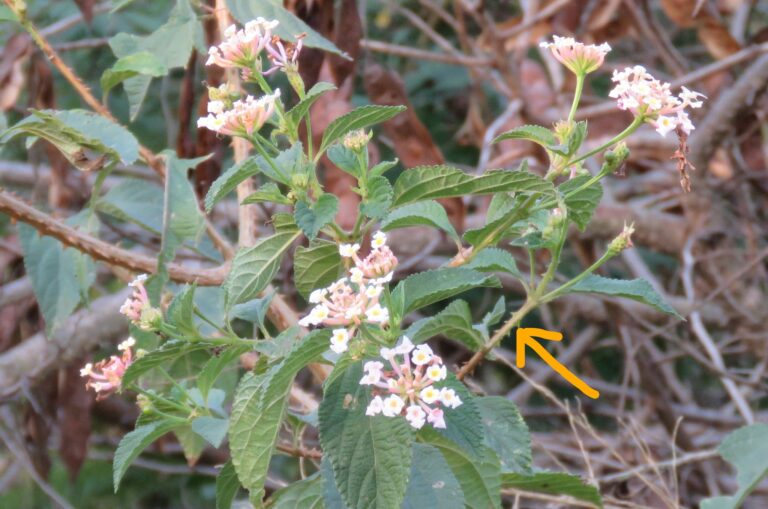
4. LANTANA (Lantana Camara). This Central and South American plant is one of the world’s worst invasives. It is a highly illegal Category 1b plant on the NEMBA list. You may not grow, transport or trade in it, and have to remove it from your property. For further information:
• Alien Invasive Plants List For South Africa (environment.co.za)
• National Environmental Management » Biodiversity Act (10/2004) » Alien and Invasive Species Lists, 2016 (b-cdn.net)
• Email Judyn@icon.co.za for ‘Alien Plants of Marloth Park’. It includes replacement plants.
Lantana has pale stems with thorns. It grows and spreads into tall, impenetrable bush.
Look out for the extensive golden webs of the striking, but harmless, Golden orb spider. The female is shown here in ventral view. Photo by HR Paul Dill-Franzen.
Follow us on Facebook for news and info about our diverse flora and fauna.
Why are honey badgers deemed to be the fiercest in the animal kingdom?
Honey badgers are not only able to accept stings from bees, but can also handle bites from the world’s deadliest snakes such as puff adders, mambas and cobras. The honey badger is not necessarily immune to these venoms, but it’s thick, tough skin prevents most bee stings and snake fangs from penetrating it. If the venom of a large snake does get into the system, the badger may be killed, but often just has a coma-like “down time” while it recovers. A badger will generally bluff, growl, and charge its way out of trouble, even holding off a pride of lions.
You don’t want to miss out on this year’s HR Conservation Calendar. It is something special! It has great photos, inspirational nature quotes, and was beautifully designed for us by local graphic designer, and friend of HR, Marietjie Bezuidenhout. It has world conservation days, plus all school and public holidays are listed at the back. Get your copy @ R110 from Rose Muldoon. (083 417 0323).
In his post to the Facebook Page, TREES IN AFRICA, Pierre Van Eeden makes the following valid point regarding the preservation of our hardwoods.
“Some interesting observations. These photos are of Trees in Shingwedzi Camp in the Kruger National Park South Africa . The first photo was taken in 1935 and the second one in 2008. That’s 86 years difference. It’s then when you realise that burning a hard wood from the veld is not a viable option at all. We must preserve our tree life at all costs. These photos were forwarded to me by Joep Stevens and I thank him for allowing me to use these photos. And now add on another 13 years to the last one.”